
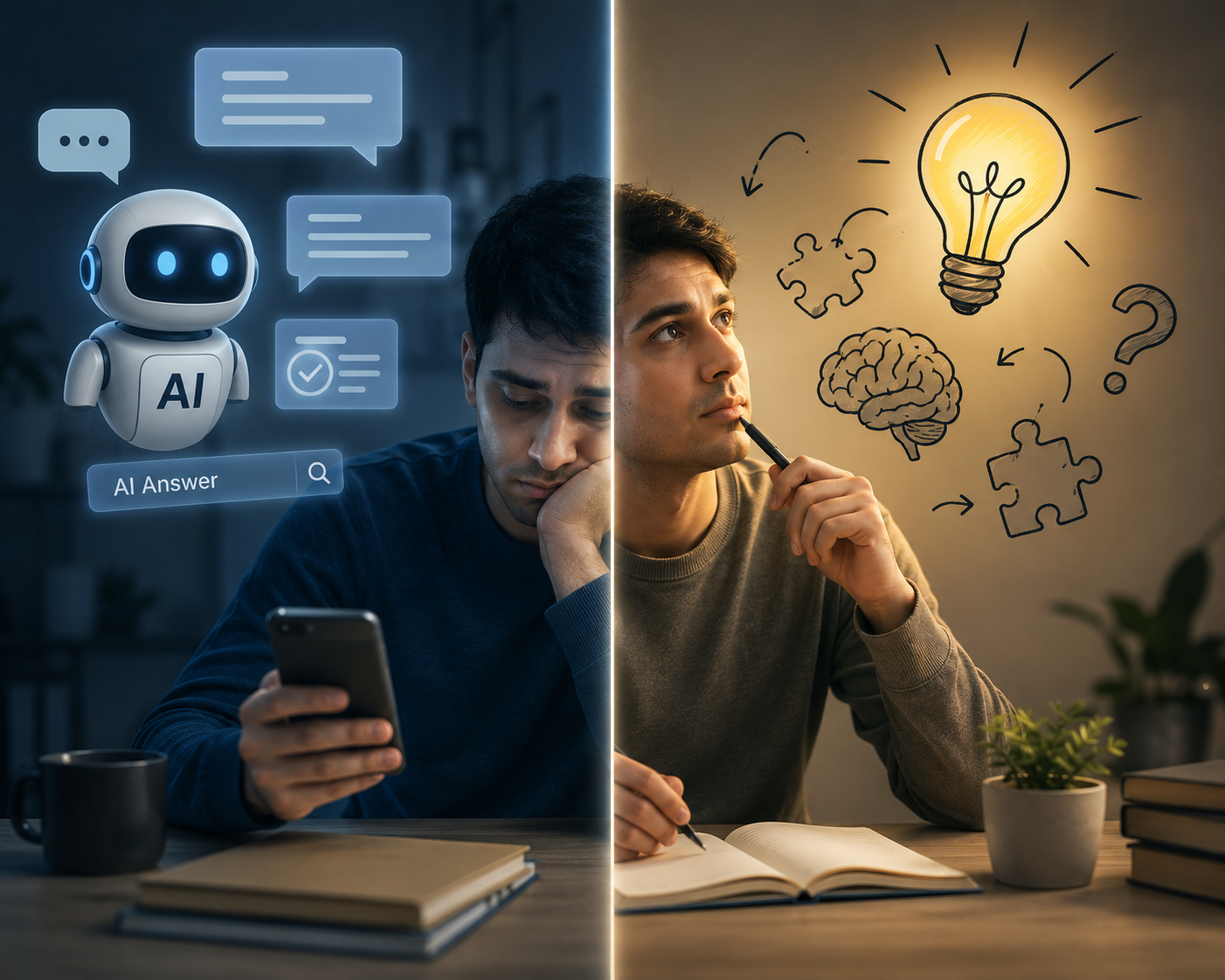
As a psychiatrist, I’m fascinated by how quickly AI has become part of our daily lives. From drafting emails to answering complex questions, AI can save time, increase productivity, and make information more accessible than ever before.
But an important question remains: Are we using AI to enhance our thinking, or to replace it?
Our brains work like muscles—the less we use certain skills, the weaker they can become over time. When we rely on AI for every answer, decision, or creative idea, we may be engaging less in critical thinking, problem-solving, and independent reasoning.
People increasingly rely on AI for answers instead of critical thinking.
- Overdependence may reduce problem-solving skills, memory retention, and independent decision-making.
- In healthcare, clinicians may become vulnerable to automation bias—accepting AI suggestions without sufficient scrutiny.
- Patients may self-diagnose using AI tools, leading to unnecessary anxiety or false reassurance.
- AI is most effective as an assistant, not a replacement for human judgment.
This doesn’t mean AI is harmful. In fact, it can be an incredibly valuable tool. The concern arises when convenience turns into dependence.
In mental health, we often talk about balance. Just as calculators didn’t eliminate the need to understand mathematics, AI shouldn’t eliminate the need to think. The goal is not to avoid AI, but to use it thoughtfully.
Perhaps the healthiest approach is to let AI assist our thinking—not do all the thinking for us.
The future may not depend on how intelligent AI becomes, but on whether we continue to exercise our own intelligence alongside it.
Have you caught yourself using AI for something you could have figured out on your own?